Contact reliability depends directly on uninterrupted, uniform pressure between the elastomeric boundary and mating metal surfaces. Parting line flash creates irregular seams that bridge sealing lips, providing micro-channels through which high-pressure oil or coolant escapes.
Dynamic fluid pulsation erodes these flash remnants over continuous operating cycles, degrading sealing performance and contaminating downstream hydraulic valves.
Dimensional stability suffers severely whenever compound leaks past designated mould cavities during high-pressure injection. Material leakage at the mould parting line can cause dimensional defects and material loss. Variations in Shore A hardness and elastic recovery should be evaluated separately against the compound specification and curing conditions.
Fluid seals operating under fluctuating temperatures experience uneven swelling if material density fluctuates across the parting seam. Precision sealing rings require sub-millimeter thickness uniformity to prevent spiral twisting and premature seal roll during high-speed pneumatic actuator strokes.
Mechanical Sources of Flash Formation in Sealing Ring Tooling
Clamping force balance and platen parallelism govern whether mould parting surfaces stay sealed under peak hydraulic cavity pressure. Uneven clamp distribution allows minute microscopic gaps to open across multi-cavity plates, inviting low-viscosity elastomers to bleed outward.
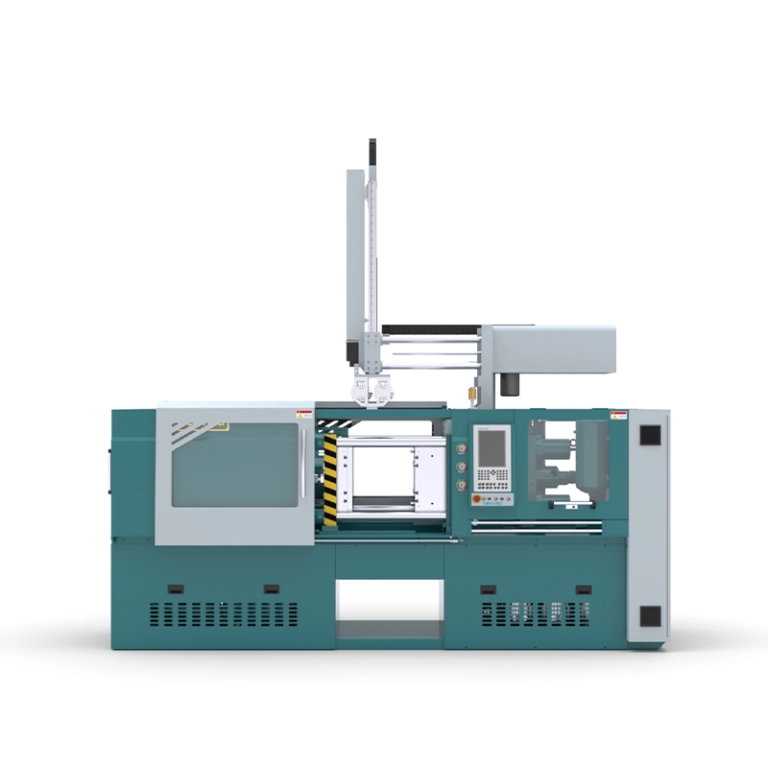
Our RH series machines are designed for sealing ring production, with clamping and injection configurations selected to meet the requirements of the mould and rubber compound.
Cavity pressure spikes generated during final mould packing frequently exceed calculated hydraulic locking thresholds. Rubber compounds exhibit viscoelastic behavior, transmitting hydrostatic pressure omnidirectionally against precision parting faces.
Improperly calibrated injection velocity transitions generate instantaneous pressure surges that lift mould plates, producing thick, difficult-to-remove parting line flash. Cushion stability and smooth pressure deceleration remain mandatory to preserve clamp closure.
Thermal Homogeneity and Vulcanization Kinetics in Flash Suppression
Compound viscosity drops precipitously upon entering hot tooling cavities, creating a fleeting processing window where rubber flows easily before cross-linking begins. Temperature variations across the mould can cause differences in curing rates between cavities, affecting part consistency and cycle time. Incorporating cold runner system injection moulding stabilizes compound temperature, keeping elastomers fluid right up to the cavity gate without premature thermal degradation.
Unequal thermal expansion across mould plates distorts finely ground parting lands. Tooling steel expands non-linearly when heating elements suffer from improper zone regulation, opening microscopic clearance paths near outer tooling margins. Achieving flashless moulding mandates synchronized multi-zone electric or thermal oil heating capable of maintaining surface temperature variances below two degrees Celsius.
Helping Reduce Waste and Pressure Spikes Through Cold Runner Engineering
Conventional runner systems trap large volumes of cured rubber scrap while generating uneven flow resistance across sprawling cavitation layouts. Transitioning to cold runner system injection moulding prevents cured runner waste by maintaining elastomers at controlled plasticizing temperatures directly above the parting line. Cold runner technology can reduce cured runner waste. Injection stroke and pressure depend on shot volume, compound flow behavior, runner design, cavity layout, and process settings.
Nozzle shut-off precision dictates whether material drool occurs between automatic machine cycles. Our RH series machines support cold runner technology for sealing ring production. Specific cooling arrangements and cavity control functions depend on the selected mould and machine configuration.
Gate design should be matched to the sealing ring geometry and rubber compound. A suitable design can help control gate remnants and reduce finishing work, depending on the product requirements.
Vacuum Evacuation and Degassing Dynamics at the Mould Parting Line
Entrapped air and moisture inside mould cavities create severe mechanical resistance against advancing elastomer melt fronts. High injection speeds compress residual pocket air adiabatically, producing diesel effect and localized blistering along delicate seal edges.
Operators often increase injection pressures to force air through micro-vents, unintentionally pushing molten rubber into venting channels and aggravating parting line flash. Porosity along critical seal lips invariably causes premature leakage.
High-efficiency vacuum chambers enclose the entire mould envelope before cavity filling commences. Evacuating atmosphere down to negative barometric pressures enables smooth material entry at reduced hydraulic injection pressures.
Evacuating trapped volatiles ensures complete cavity packing without forcing low-viscosity elastomer past parting line boundaries, directly preserving edge integrity across intricate injection molded rubber parts.
Economic and Post-Processing Impacts of Flashless Rubber Production
Secondary finishing procedures introduce hidden production costs and severe quality hazards. Cryogenic tumbling and vibratory deflashing can remove excess rubber, but process parameters must be selected carefully to avoid damaging delicate sealing features.
Combining cold runner technology with effective flash control can reduce material waste and secondary finishing requirements. Whether parts can proceed directly to final inspection depends on their quality specifications.
Scrap reduction directly shifts overall plant profitability when processing expensive synthetic compounds like fluoroelastomers and hydrogenated nitrile. Raw compound waste generated by oversized runners and trimming flash often constitutes thirty percent of total batch weight.
Optimizing flash control through tailored Dekuma machine configurations helps improve compound utilisation and reduce vulcanized scrap, supporting more efficient production of saleable rubber components.
Achieving exceptional seal longevity requires engineering every phase of the injection cycle around parting line stability. Helping reduce flash at the source protects dimensional profiles, prevents premature fluid leaks, and optimizes cycle efficiency across continuous manufacturing operations.
Investing in rigid clamping, precise thermal regulation, and advanced vacuum systems remains the only reliable route to producing flawless, high-performance injection molded rubber parts.