
Long rod insulators and hollow core insulators require large quantities of silicone rubber to be injected into molds with substantial dimensions. The rubber must reach the required areas of the cavity without unstable feeding or excessive air entrapment, while the mold remains securely clamped during injection and curing. For these products, injection volume, plasticization, mold space, and stroke control directly affect the feasibility of the molding process.
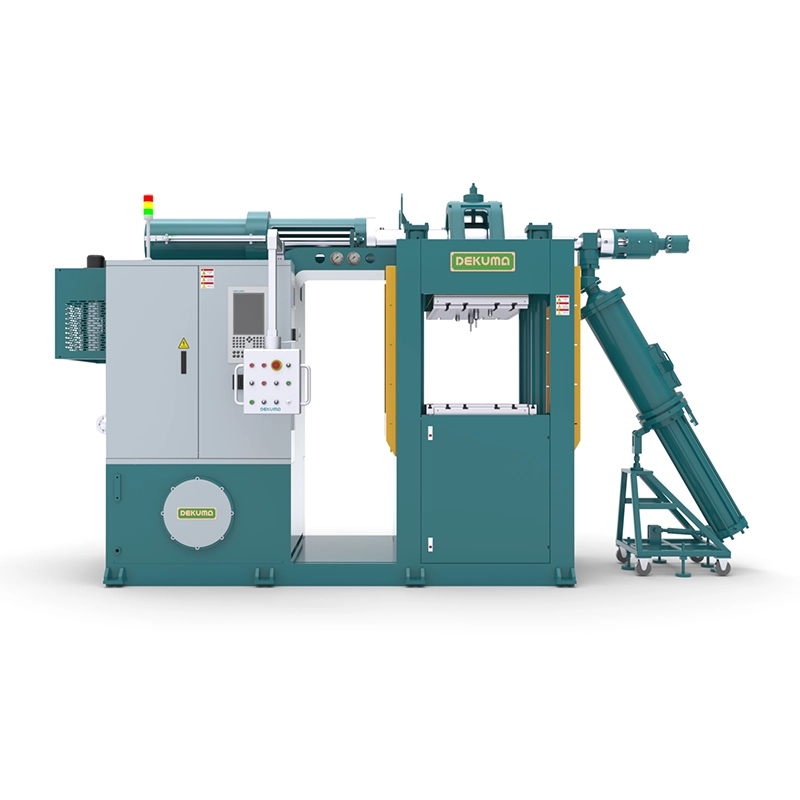
A silicone rubber injection molding machine therefore needs to match the actual insulator and mold rather than being selected from injection capacity alone. Our RA Series is designed for electrical insulator production, covering applications such as long rod insulators, hollow core insulators, surge arresters, cable accessories, and switchgear.
What Makes Insulator Molding Different?
The main challenge is the combination of product size and material behavior. A long rod insulator can require a long mold and a large rubber shot, while a hollow core insulator may demand substantial clamping capacity and mold-opening space. Surge arresters, cable accessories, and switchgear introduce different geometries and production requirements.
This is why material preparation cannot be separated from injection performance. The RA Series uses an enhanced screw design to improve rubber feeding consistency, homogenization, and degassing. For large silicone rubber shots, these functions help establish more uniform material conditions before injection begins.
The machine also uses double-layer thermal insulation plates designed for high pressure and temperature. The official product information states that this structure can reduce energy consumption by approximately 40% while reducing thermal stress on machine components.
Material Preparation Sets the Foundation
Silicone rubber needs to reach a consistent condition before it enters a large or complex mold. Inadequate mixing or trapped air can interfere with filling and create unwanted variations in molded products. For electrical insulation components, where dimensional consistency and product integrity matter, material preparation deserves attention alongside injection pressure and clamping force.
Our injection system addresses this stage through the screw and material-processing design. Consistent feeding supports stable plasticization, while homogenization helps distribute the compound more evenly. Degassing is also integrated into the process to improve air removal before injection.
The same equipment platform can process silicone rubber and EPDM. This is useful for manufacturers whose product portfolio includes different rubber materials, because material compatibility can be considered during machine selection instead of requiring a completely separate equipment strategy.
Machine Architecture Matters During Injection
Once the material is prepared, the machine must maintain stable injection and clamping movements. Large molds can amplify the effect of positioning errors, making stroke control particularly important during mold closing, injection, and switching operations.
The RA Series uses non-contact linear transducers for closed-loop control of both clamping and injection strokes. The listed theoretical precision is 0.05%, supporting mold positioning, shot-size control, and switching-point accuracy.
Hydraulic stability is another part of the machine architecture. The equipment uses an American high-pressure pump and German hydraulic valves. These components are intended to provide stable hydraulic operation and accurate control during silicone rubber high-voltage insulator production.
At Dekuma, these systems are treated as connected parts of the molding process. Material preparation, injection, clamping, and movement control need to work together because a weakness in one stage can affect the consistency of the finished insulator.
How to Match the Machine to the Mold
A silicone injection molding machine should be selected after the product and mold requirements have been established. Injection volume needs to accommodate the required rubber shot, while clamping force must correspond with the mold and injection conditions. Mold opening stroke, heating-plate dimensions, and minimum mold thickness also determine whether a particular configuration is practical.
The RA Series provides configurations for both rod and hollow insulator production. Its listed injection volumes range from 4,000/5,000 cc to 40,000 cc for rod-insulator models and from 18,000 cc to 50,000 × 2 cc for hollow-insulator models. Clamping forces range from 3,000 to 15,000 kN for rod-insulator configurations and from 6,500 to 24,000 kN for hollow-insulator configurations.
Mold dimensions should be checked against the same table. The listed distance between heating plates ranges from 650 to 2,000 mm, while heating-plate dimensions extend from 600 × 1,000 mm to 1,500 × 3,000 mm. This information provides a direct reference when determining whether the machine can accommodate the intended mold.
What to Check Before Choosing the Machine
Selecting a silicone injection molding machine should start with the mold and finished insulator requirements rather than the machine model itself. The required mold length and width determine the available mold space, while the product’s rubber volume determines the necessary injection capacity. The mold structure then helps establish the required clamping force and opening stroke.
Material preparation should be checked at the same time. If the production process requires consistent silicone rubber feeding, homogenization, and degassing, the injection system needs to provide these functions before the material reaches the mold. For large insulators, this can be more relevant than simply choosing a machine with a larger nominal shot volume.
The RA Series provides separate configurations for rod and hollow insulators, with different injection volumes, clamping forces, mold spaces, and stroke ranges. The official specifications also include closed-loop control of the injection and clamping strokes, with a theoretical precision of 0.05%.
At Dekuma, the machine configuration can be discussed around the actual insulator, mold, silicone rubber volume, and production target. That makes the equipment decision more straightforward: first confirm what the mold requires, then check whether the injection, clamping, heating, and control systems provide the necessary range.