
A rubber track vulcanizing press has to accommodate the entire track within the mold while maintaining pressure and temperature throughout curing. Track width, length, mold thickness, and heating-plate dimensions directly determine whether a press can handle the intended product. For manufacturers producing different track specifications, these parameters are therefore the starting point for equipment selection.
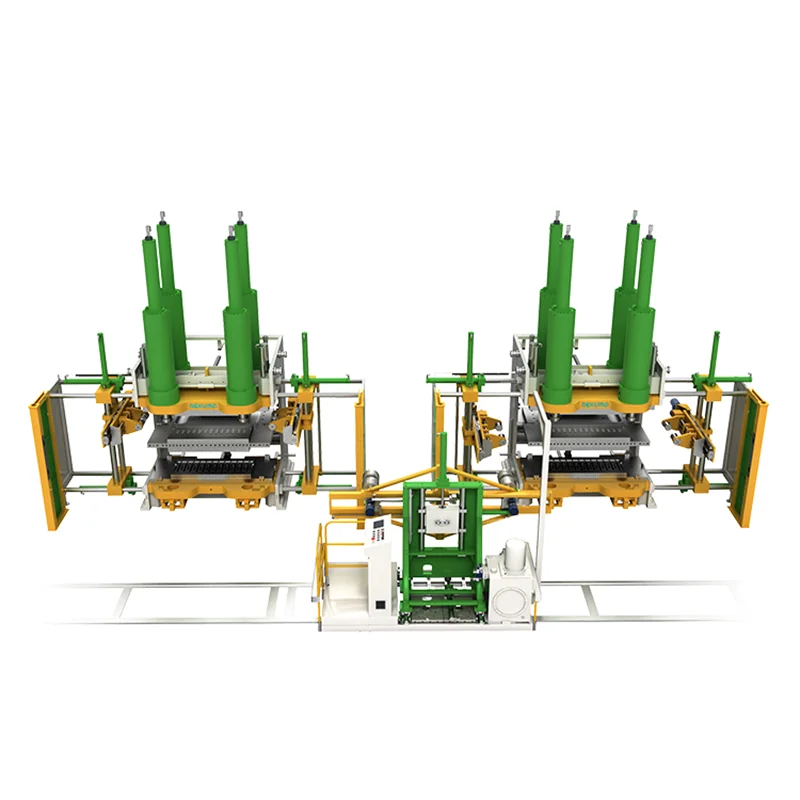
The challenge becomes greater when the production line must handle automatic loading, demolding, material retrieval, and different track sizes. A suitable rubber vulcanizing press machine needs to provide sufficient clamping capacity while fitting the mold and production workflow. Press configuration, automation, and process control should be evaluated together.
Applications of Rubber Track Vulcanization
Rubber tracks are used for agricultural machinery, construction equipment, military vehicles, and snowmobiles. These applications can involve substantially different track dimensions, so the required press capacity is not determined by application category alone. Track length, width, mold structure, and expected production volume all need to be considered.
The vulcanization process also needs to maintain the position of the track reinforcement. Our production line integrates a constant-tension steel cord system with the vulcanizing unit. This configuration is designed to support seamless load-bearing tracks by maintaining consistent tension during production.
The track’s application also affects its construction and vulcanization requirements. Agricultural and construction equipment may use tracks designed for sustained load and frequent ground contact, while military vehicles and snowmobiles can require different dimensions and structural characteristics. A rubber track vulcanizing machine must therefore provide sufficient process control to accommodate the requirements of the specific track design.
Process Requirements for the Vulcanizing Press
Heat, pressure, and curing time are the core parameters of rubber track vulcanization. The mold must maintain suitable conditions throughout the cycle so that the rubber cures consistently while retaining the required track geometry.
Clamping capacity should correspond with the mold and track size. Our RC series includes models with clamping forces from 200 to 900 tons. Heating-plate dimensions range from 1,200 × 650 mm to 2,500 × 1,050 mm, providing different configurations for different mold requirements.
Mold thickness and track dimensions should also be checked before selecting the press. The listed minimum mold thickness ranges from 100 to 180 mm, while the maximum track width ranges from 150–500 mm on the DKM-RC200 to 915 mm on the DKM-RC650 and DKM-RC900.
Equipment Selection for Different Track Sizes
Track length is another important selection parameter. The RC series covers listed track ranges from 2,500–3,800 mm on the DKM-RC200 to 8,000–12,000 mm on the DKM-RC900. Matching this range with the planned product portfolio helps prevent a mismatch between the press, mold, and finished track dimensions.
Production volume can influence the required level of automation. High-volume production may benefit from automatic rubber loading, demolding, and material retrieval, while manufacturers with multiple track specifications may place greater emphasis on flexible settings and recipe management.
The listed system pressure is 210 bar across the RC series. Rather than selecting equipment according to pressure alone, manufacturers should evaluate system pressure together with clamping force, heating-plate dimensions, mold thickness, and track size.
Automation and Process Control
Automation can reduce manual intervention during repetitive track production. Dekuma integrates automatic loading, demolding, and material retrieval into the track production line, helping streamline material handling and reduce manual operations during the molding cycle.
Process monitoring is also relevant during extended curing cycles. The customized B&R control system provides temperature control, fast response, and production-recipe storage. Integration with the iSee4.0 intelligent management cloud platform allows monitoring of energy consumption, temperature, pressure, clamping force, and time.
Energy management can be considered as part of the press configuration. Our intelligent curing shutdown system stops the main motor during the curing period while retaining pressure, reducing unnecessary motor operation without releasing the required lock-in pressure.
How to Select the Right Vulcanizing Press
When comparing a rubber track vulcanizing machine, manufacturers should first establish the track dimensions and mold requirements. Track width, length, mold thickness, heating-plate size, and expected output provide the basis for determining suitable clamping capacity and machine configuration.
For manufacturers evaluating a rubber vulcanizing press machine, the key question is whether the press can maintain stable clamping and curing conditions throughout the planned production cycle. Mold dimensions, track construction, curing time, and expected output should be assessed together before the final machine configuration is determined.
Our RC series provides seven clamping-force options from 200 to 900 tons, with different heating-plate dimensions and track ranges. This allows machine capacity to be matched with different rubber track specifications and production conditions.
At Dekuma, these parameters are considered together with the molding process and factory workflow, providing a practical basis for selecting a vulcanizing press that fits the intended rubber track production requirements.This approach also gives manufacturers greater flexibility when expanding their track product range or adapting the production line to new specifications.