
Two rubber injection molding machines can show similar figures for injection pressure, clamping force, or injection volume and still perform differently after they enter production. The difference often lies in less visible factors: how the core systems are designed, how accurately movement is monitored, how consistently components are manufactured, and how quickly technical problems can be addressed. For buyers comparing rubber injection molding machine manufacturers, these factors provide a more useful basis than a specification sheet alone.
The same principle applies to after-sales service. Installation, commissioning, operator training, spare-parts supply, and technical troubleshooting can all affect the time required to reach stable production. A capable rubber machine manufacturer therefore needs to demonstrate both equipment competence and the technical resources that remain available after delivery.
Build Quality: Look Behind the Specification
Machine quality starts with the systems that directly control the molding cycle. The injection unit needs to deliver the required material volume consistently, while the clamping system must maintain the mold position and required pressure throughout injection and vulcanization.
Hydraulic and electrical components also deserve attention. Pressure instability, leakage, inaccurate movement, or unreliable signals can create variation that may not be obvious during a short machine demonstration. Structural rigidity matters as well because the machine needs to maintain its mechanical relationships under repeated clamping and injection loads.
A useful evaluation should therefore go beyond asking which components are installed. Buyers can also ask who designs the core systems, how structural components are processed, what quality controls are applied during assembly, and whether the manufacturer has the engineering resources to modify the machine for a specific application.
Our manufacturing process follows this approach. Core machinery components are designed by our technical team, while raw materials and components are selected and processed according to defined technical standards. This gives the machine structure a clear connection between engineering design and production quality.
Precision: Focus on Repeatable Control
Precision in rubber molding is not simply a matter of achieving one accurate movement. Production depends on repeating the same injection, clamping, and mold-positioning conditions from one cycle to the next.
Stroke feedback is one practical example. The RV Series uses a non-contact electronic ruler for injection and clamping stroke monitoring, with a theoretical precision of ±0.05%. More consistent position feedback gives the control system a stable reference for managing injection and clamping movements.
The importance of this becomes clearer when a product has tight dimensional requirements. If the injection stroke or switching position varies, the amount of material entering the cavity or the timing of a process stage can also change. Consistent feedback helps reduce this source of variation and gives operators more reliable process information.
A precision assessment should therefore consider not only the final numerical specification, but also how the machine measures movement, controls pressure and flow, records process conditions, and maintains the same sequence throughout repeated production cycles.
Manufacturing Capability: Can the Supplier Adapt the Machine?
A supplier’s product range can reveal how broadly its manufacturing capability has been developed. For a rubber machine manufacturer, the ability to support different rubber materials and product types is closely related to engineering capability. Different applications may require different combinations of injection capacity, mold space, temperature control, dosing, and automation.
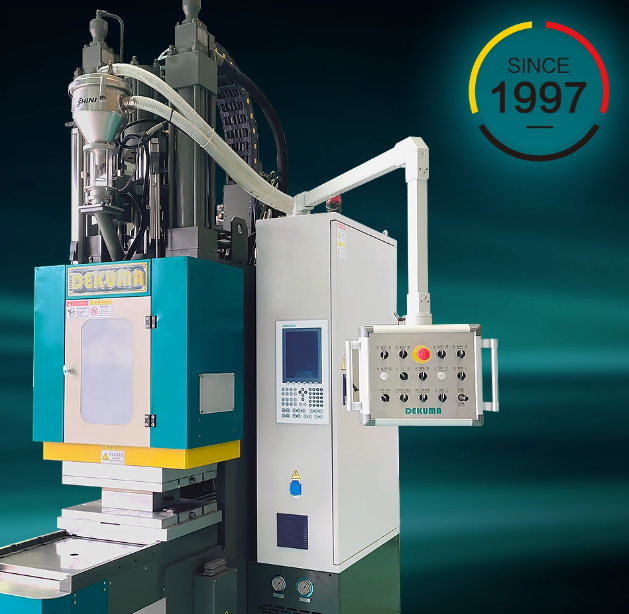
Our machine portfolio at Dekuma includes RV, RV-Se, RC, RA, RT, RI, and other specialized equipment. The RV-Se Series, for example, is designed for TPV, TPE, flexible modified PVC, and other injection-molded materials. The RC Series is aimed at precision rubber parts, sealing-strip joints, seals, skeleton oil seals, and TPU products.
These distinctions matter because a manufacturer should not have to force every rubber product into the same machine configuration. Material characteristics and product geometry should influence the injection system, mold arrangement, and process controls selected for the project.
For buyers evaluating rubber injection molding machine manufacturers, customization capability is another important consideration. A manufacturer with its own engineering and production resources is better positioned to adjust machine configuration, integrate automation, and coordinate equipment with specific molds and production requirements.
Technical Support: What Happens After Delivery?
A machine does not become productive simply because it arrives at the factory. Installation, commissioning, mold setup, parameter adjustment, and operator training can all affect the transition from delivery to regular production.
Technical support should therefore be assessed across the equipment’s operating life. Before production, buyers should look at installation and commissioning procedures. During production, remote troubleshooting and technical assistance can reduce downtime when unexpected problems occur. Over the longer term, spare-parts availability and preventive maintenance become increasingly important.
Our service structure covers on-site inspection, installation and commissioning, customized training, spare-parts service, remote technical assistance, and 24/7 support. At Dekuma, these functions are handled as part of the equipment supply process rather than treated as separate after-sales items.
Check What the Manufacturer Can Demonstrate
A supplier’s claims become more useful when they can be checked against actual engineering and service details. Ask how the machine’s core systems are designed, which parts are produced or controlled internally, and how machine performance is verified before delivery. For precision applications, request information about stroke measurement, pressure control, and repeatability rather than looking only at maximum machine capacity.
The same approach applies to technical support. Before placing an order, it is worth confirming who handles installation and commissioning, how operator training is arranged, how spare parts are supplied, and whether technical assistance is available when production problems occur. These details are easier to evaluate before a machine is purchased than after an unexpected shutdown.
For a buyer comparing rubber injection molding machine manufacturers, these are the details that can be verified directly before purchase and followed through after installation. The equipment, engineering process, and service arrangements should all withstand that level of scrutiny.