
A long-rod insulator can require a mold opening stroke of 1,600 mm and a heating-plate spacing of 2,200 mm, while a hollow core insulator may require up to 50,000 cc of injection volume. These are not minor differences in machine selection. They determine the physical size, injection capacity, and clamping configuration required before production can begin.
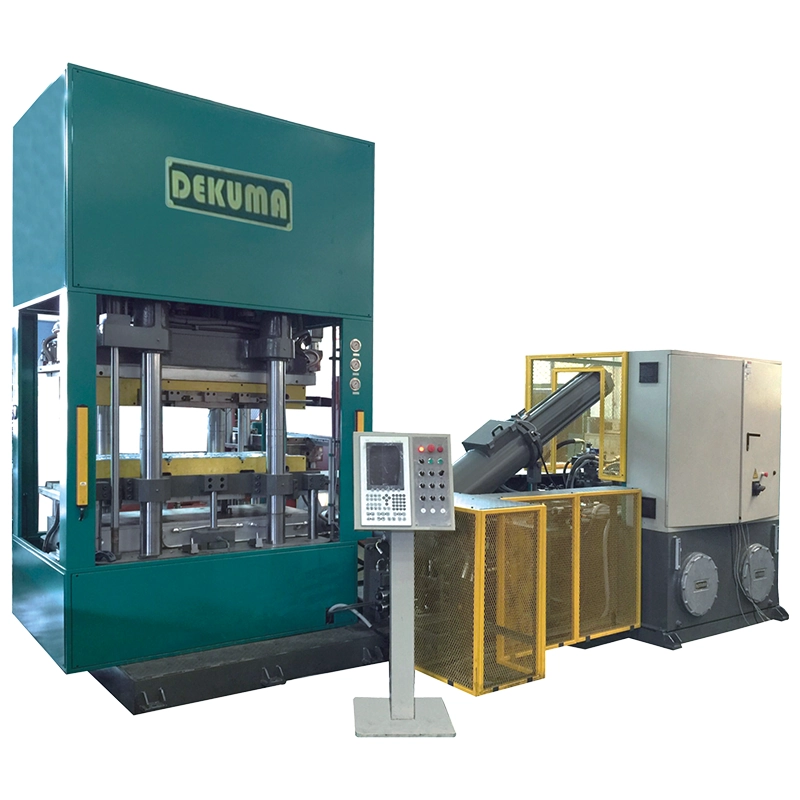
For HTV silicone insulation products, the machine therefore needs to be matched to the actual product and mold rather than selected from clamping force alone. Our RT Series is built specifically for HTV silicone rubber and covers applications such as long-rod insulators, hollow core bushings, arresters, cable accessories, and switchgear.
Start With the Insulator, Not the Machine
The first distinction is the product itself. Long-rod insulators and hollow core bushings do not place the same demands on molding equipment.
For long-rod insulators, mold length and opening stroke can become limiting factors because the tooling must provide enough space for the complete product. The RT Series includes configurations with 700, 800, and 1,600 mm mold-opening strokes, with heating-plate spacing extending from 940 to 2,200 mm.
Hollow core products can create a different challenge. The required silicone volume and mold dimensions may demand substantially greater injection and clamping capacity. The RT1500 configuration, for example, provides 40,000/50,000 cc of injection volume and 15,000 kN of clamping force.
This is why an HTV silicone insulators injection machine should be evaluated against the dimensions and material requirements of the intended product. A machine that works for one insulator design may not provide the injection volume, mold space, or opening stroke needed for another.
What the RT Series Does Differently
Large-format silicone molding also creates practical problems during mold changes. Heavy tooling can make adjustment slow and difficult if the machine provides little control over mold height.
The RT Series uses hydraulic blocks for mold-height adjustment. For large HTV silicone molds, this gives us more control over mold positioning during tooling changes and reduces repeated manual adjustment around heavy tooling. This configuration is part of our approach at Dekuma to make large-format insulation molds easier to handle during production.
The clamping unit uses a block-type structure to keep the mold load centered during operation. When the mold reaches the maximum opening position, the blocks lock automatically, helping protect the mechanical, hydraulic, and electrical components during this stage.
Injection Quality Depends on More Than Shot Size
HTV silicone processing requires the material to reach the cavity in a sufficiently homogeneous condition. Simply having enough injection volume does not guarantee effective filling.
The RT Series uses an injection system designed around plasticization, feeding, homogenization, and venting. The product information specifically notes improved screw feeding, more even material mixing, and enhanced release of trapped air.
For a long insulator, these functions become relevant because the silicone must travel through a large mold cavity. Air management and material consistency can affect how completely the cavity fills and how stable the molded product remains from cycle to cycle.
The listed RT configurations use 1,200 bar injection pressure, with screw diameters of 65 or 90 mm. Injection volume ranges from 13,000 to 50,000 cc depending on configuration.
For a rubber injection molding machine, these specifications should be compared with the actual shot requirement rather than viewed separately. Product volume, runner requirements, mold layout, and material characteristics should all be considered before the injection capacity is selected.
Match Clamping Capacity to the Mold
Clamping force needs to be sufficient for the mold and injection conditions, but the physical mold envelope can be equally restrictive.
The RT Series ranges from 5,600 to 15,000 kN in clamping force. Minimum mold thickness varies from 280 to 600 mm across the listed configurations, while heating-plate dimensions range from 1,600 × 630 mm to 3,600 × 830 mm.
These figures give production teams a concrete way to narrow the equipment range. A long-rod application may place greater emphasis on opening stroke and heating-plate dimensions. A hollow core application may shift attention toward injection volume, clamping force, and mold thickness.
The machine dimensions should also be checked during project planning. The largest listed RT configuration measures 11.8 × 6.3 × 7.4 m and weighs 70 tons, so factory layout, installation access, and foundation planning cannot be treated as afterthoughts.
A More Direct Way to Choose the Configuration
For manufacturers comparing an HTV silicone insulators injection machine, selection should start with the actual insulator and mold. Product length, silicone volume, mold dimensions, mold thickness, opening requirements, and clamping needs provide a more useful basis than choosing a machine by size alone. Long-rod insulators may require more mold space, while hollow core products can place greater demands on injection capacity.
At Dekuma, these production conditions form the basis for configuring the RT Series. The product structure, material volume, tooling, and molding sequence are considered together so that the machine arrangement corresponds to the intended application rather than treating all HTV silicone insulation products in the same way.
For a rubber injection molding machine, the final check is whether the equipment can support the complete process from material injection through mold opening and part removal. When selecting an HTV silicone insulators injection machine, manufacturers can use the actual product and tooling requirements to determine the suitable configuration, with Dekuma providing the RT Series for large-format HTV silicone insulation applications.