
Producing reliable silicone insulation components requires accurate control of material behavior, mold design, and processing conditions. For manufacturers of insulators, bushings, arresters, and switchgear parts, even small variations during molding may influence product quality, including insulation performance, dimensional consistency, and service reliability.
High-temperature vulcanized silicone rubber is widely used in electrical insulation applications because it provides strong resistance to weather aging, moisture, ultraviolet exposure, and temperature changes. However, the material itself does not guarantee product performance. The injection molding process must also provide stable filling, effective venting, and consistent curing conditions.
Material Requirements for HTV Silicone Rubber Electrical Components
Manufacturers select HTV silicone rubber for electrical components that operate in demanding outdoor environments. Its hydrophobic characteristics help maintain insulation performance by reducing the impact of moisture and surface contamination.
Compared with some traditional elastomer materials, silicone rubber offers advantages in maintaining stability during long-term exposure. However, its processing characteristics require careful equipment selection. The material must be evenly plasticized and injected into the mold under controlled conditions to avoid defects inside the finished component.
For this reason, production teams need to evaluate both material properties and machine capabilities. A suitable molding system should support stable processing while meeting the specific requirements of different insulation products.
Key Factors When Selecting an HTV Silicone Insulator Injection Machine
Choosing an HTV silicone insulators injection machine requires manufacturers to consider more than injection capacity. The machine structure, injection accuracy, clamping stability, and mold adaptability all influence the final production result.
The injection system is a key factor because silicone insulation products often have complex geometries and large molding areas. Stable material feeding and injection help ensure that the rubber compound reaches every part of the cavity with consistent pressure.
Clamping performance is equally important. During molding, the machine must maintain balanced locking force to prevent mold movement and uneven pressure distribution. This is especially important for long products such as composite insulators, where dimensional accuracy is closely related to production stability.
Mold change efficiency should also be considered. Electrical component manufacturers may produce different insulation products based on customer requirements. Equipment with convenient mold adjustment features can reduce setup time and improve production flexibility.
Equipment Considerations for Insulators, Bushings, Arresters, and Switchgear Parts
Different electrical components require different molding capabilities. Long-rod insulators usually require sufficient mold space and stable injection performance because the material must fill a long cavity evenly.
For bushings and arresters, internal quality control is a major concern. Proper venting and stable material flow help reduce the possibility of air entrapment and improve product consistency.
Switchgear parts and cable accessories often require repeatable production over large quantities. In these applications, manufacturers need equipment that can maintain stable cycles while reducing variation between different batches.
These requirements mean that equipment selection should be based on actual product conditions rather than general machine specifications. The right solution needs to match the material, mold design, and production goals.
RT Series Rubber Injection Molding Machine for Silicone Insulation Production
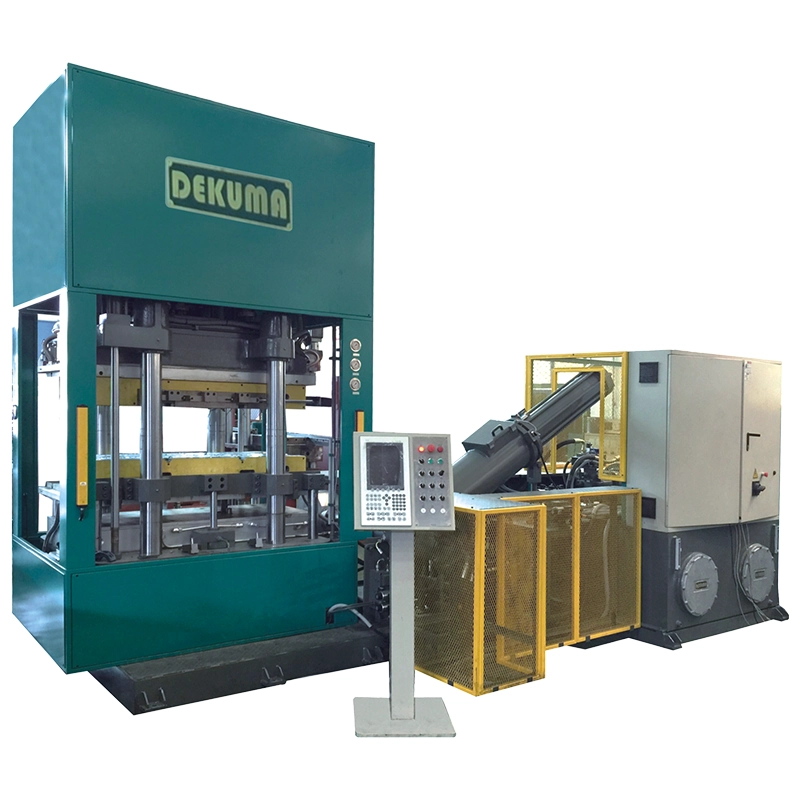
With our experience as Dekuma, we design rubber injection molding solutions according to the practical requirements of power industry manufacturers. The RT Series Rubber Injection Molding Machine is developed for producing long-rod insulators, hollow core bushings, surge arresters, cable accessories, and switchgear components.
As an HTV silicone insulators injection machine, the RT Series features a top-opening mold structure that reduces the operating height and improves accessibility during mold installation and maintenance. This design helps operators manage large molds more efficiently during production.
The block-type clamping unit keeps mold weight centered, helping maintain balanced clamping performance during molding. For manufacturers producing large silicone insulation components, this structure supports more stable pressure distribution and consistent product quality.
The RT Series also uses hydraulic mold thickness adjustment, allowing faster and more accurate mold setup. This feature helps manufacturers handle different product specifications while reducing downtime caused by frequent mold changes.
The optimized plasticization and injection system improves material feeding, homogenization, and venting performance. These functions are important when processing high-temperature vulcanized silicone rubber, as stable material preparation directly affects filling quality and molding consistency.
The machine is equipped with an Austrian B&R control system and a 10.4-inch TFT color touch screen. The control interface allows operators to monitor production conditions and adjust parameters more conveniently, helping maintain stable operation during daily manufacturing.
Building Stable Production Processes for Silicone Insulation Products
Selecting molding equipment for electrical insulation components requires consideration of current production needs and future product requirements. Factors such as component size, material characteristics, mold structure, and output targets all influence the most suitable equipment configuration.
Our rubber injection molding solutions focus on improving process stability and production consistency. Supported by the technology developed at Dekuma, we continue to optimize equipment designs for manufacturers working with demanding rubber applications.
When producing electrical components with high-temperature vulcanized silicone rubber, the combination of suitable material processing and reliable molding equipment determines the consistency of the final products. Choosing the right machine helps manufacturers reduce production risks and establish a more efficient manufacturing process for long-term applications.