
Automotive glass encapsulation requires accurate control of rubber flow, glass positioning, and molding pressure. For manufacturers producing TPV window edges and triangular window assemblies, the challenge is not only forming a rubber profile around the glass insert but also maintaining consistent dimensions and appearance during continuous production.
Unlike simple rubber parts, encapsulated glass components combine rigid glass with flexible sealing materials in one molded structure. Any variation in injection volume, mold alignment, or material distribution may affect sealing performance and assembly accuracy. Therefore, selecting a suitable glass molding machine is an important decision for automotive suppliers that require stable production quality.
TPV Glass Encapsulation Challenges in Automotive Production
TPV is widely used for automotive sealing components because it combines the elastic properties of rubber with the processing advantages of thermoplastic materials. It provides resistance to weather exposure, temperature changes, and environmental aging, making it suitable for exterior window sealing applications.
However, TPV encapsulation places strict requirements on the molding process. The material needs to flow evenly around the glass insert while maintaining consistent thickness along complex edges. If injection conditions are unstable, manufacturers may encounter issues such as incomplete filling, uneven sealing profiles, or visible surface defects.
Triangular window assemblies create additional challenges because their geometry is more complex than standard straight glass parts. The mold must accurately position the glass insert, while the injection system must deliver sufficient material flow to every section of the cavity.
For automotive suppliers, production consistency is as important as individual part quality. Large-volume manufacturing requires equipment that can maintain the same molding conditions across thousands of cycles without frequent manual adjustments.
Machine Factors That Influence Encapsulation Quality
When choosing a glass molding machine, manufacturers should evaluate how each machine function affects the final encapsulation result.
Injection accuracy is one of the most important factors. Automotive glass components often include narrow sealing areas and irregular profiles, which require precise control of injection volume. A stable injection system helps ensure that TPV fills the cavity evenly and reduces variations between different production cycles.
Material handling is another consideration. During automotive production, manufacturers may need to process different materials or adjust production schedules according to vehicle models. Faster material replacement can reduce downtime and improve production flexibility.
Mold stability also directly affects product quality. During encapsulation, the glass insert must remain fixed while the rubber material is injected around it. An unstable clamping system may cause glass displacement, uneven rubber thickness, or dimensional inconsistencies.
For this reason, equipment selection should focus not only on machine capacity but also on whether the structure and control system can support precise encapsulation processes.
Rubber Injection Molding Machine for Auto Glass Encapsulation
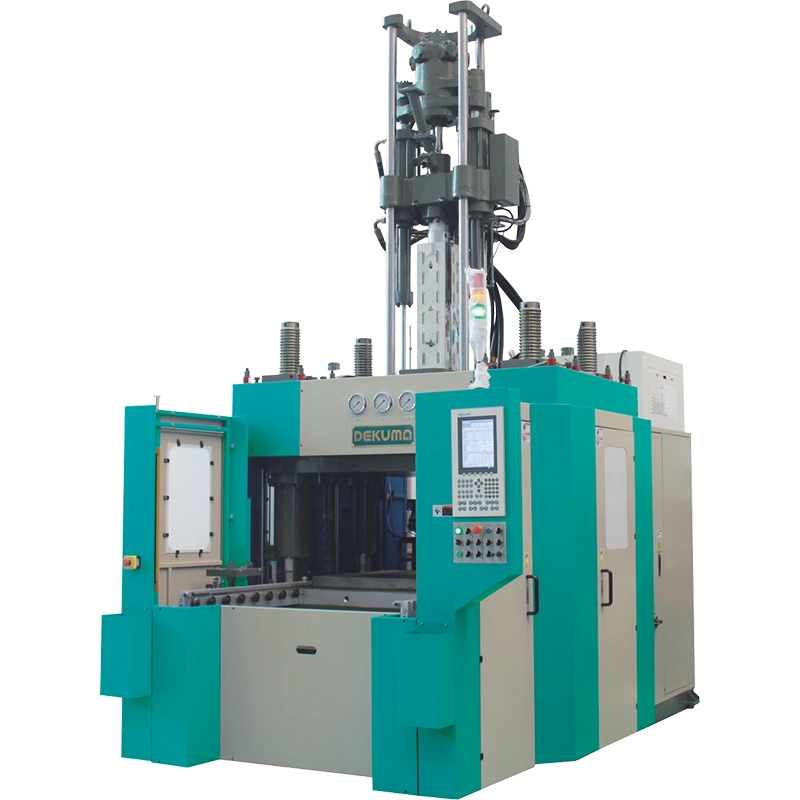
With our experience as Dekuma, we develop rubber injection molding solutions based on the requirements of automotive component manufacturers. Our equipment is designed for one-piece TPV automotive window sealing applications, including large-size vehicle windows and triangular window assemblies.
Our rubber injection molding machine for auto glass encapsulation uses a FIFO (First-In-First-Out) vertical injection unit. This design improves material replacement efficiency by reducing the amount of remaining material inside the injection chamber. For manufacturers that frequently change production conditions, this feature helps shorten preparation time and maintain consistent material performance.
The machine adopts a fixed lower platen and movable upper platen structure combined with four-column clamping. This configuration helps distribute clamping force evenly and maintain stable mold alignment during injection. For triangular window assemblies, accurate glass positioning is essential because even small movement can influence the final sealing edge.
The low working platform design improves accessibility during operation and mold handling. This is especially useful for automotive glass applications where operators need convenient access to larger molds and inserts.
The injection system includes a patented injection structure, servo motor pump, and hydraulic control system. These features help maintain accurate injection volume and repeatability, which are important for TPV encapsulation where material distribution directly affects sealing quality.
The servo system adjusts pressure and flow according to actual production requirements. Compared with conventional systems that may maintain unnecessary output, this approach helps reduce energy consumption while keeping the injection process stable.
Equipment Selection for TPV Window Edge Production
Before investing in equipment, manufacturers should evaluate the relationship between product design, TPV material characteristics, and production targets. Large glass components, complex sealing profiles, and high-volume production all require different considerations during machine selection.
A suitable rubber injection molding machine for auto glass encapsulation should provide more than basic injection capability. It needs to support accurate glass positioning, stable material flow, and repeatable molding performance throughout daily operation.
The experience accumulated at Dekuma supports our continuous development of rubber injection molding equipment for automotive applications. By focusing on practical production requirements, we help manufacturers select equipment that matches their specific glass encapsulation processes.
For companies producing TPV window edges and triangular window assemblies, the right machine configuration can reduce process variation and simplify production management. Careful equipment selection allows manufacturers to achieve consistent encapsulation quality while meeting the strict requirements of automotive supply chains.