
A standard rubber molding machine can have enough injection capacity for a specialized part and still be unsuitable for the actual production process. The limitation may come from the tooling: a heavy mold may need dedicated support, an insert may require controlled positioning, or a deep cavity may need a particular ejection arrangement. These details can change the machine configuration before injection volume or clamping force becomes the main concern.
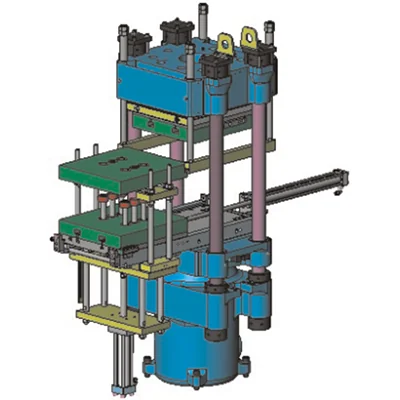
For complex components, custom rubber molding is therefore closely tied to the mold and its operating sequence. The useful question is not how many options a machine has, but which options remove an actual restriction in production. A custom injection molding machine makes sense when its configuration corresponds to the material, tooling, and operations required by the part.
When the Mold Becomes the Constraint
Mold weight and movement can create problems long before the first molding cycle. Large tooling may require lifting during installation, while some molds need additional support after they are positioned. A mold with multiple layers or sliding sections can also require movement that a basic clamping arrangement does not provide.
Our options include upper mechanical or hydraulic mold lifting, lower mechanical mold holding, lower hydraulic mold support, and mid-mold or lower-mold sliding. These are not interchangeable features. Their usefulness depends on how the tooling is loaded, supported, opened, and removed.
For example, a heavy mold may benefit from hydraulic support during positioning and operation. A sliding mold may reduce the handling work required between production stages. Selecting the option from the mold’s actual movement requirements is more practical than adding every available function to the machine.
Separate Control for Plasticizing and Injection
Complex rubber parts can also expose weaknesses in material preparation. A long flow path, narrow cavity, or multi-cavity mold may require stable material delivery throughout the injection cycle. The compound’s temperature behavior can further affect plasticizing and filling.
Our injection system separates plasticizing from injection. The plasticizing and injection sections have their own functions, while the system provides three injection zones and three dwell zones for pressure and speed adjustment. The screw slows before plasticizing is completed, and the injection piston is designed for easier disassembly.
Temperature control can also be configured around the process. Separate heat-transfer oil systems are available for plasticizing and the injection barrel, allowing their temperatures to be controlled independently. This is useful when the selected rubber compound requires different thermal conditions in these areas.
For a custom injection molding machine, these functions become relevant when the compound and mold create requirements that a fixed injection setup cannot address. The configuration should follow the processing window of the material rather than simply adding injection capacity.
Complex Tooling Changes the Clamping and Ejection Setup
The finished part may look small while the mold itself is large, heavy, or mechanically complicated. Inserts, undercuts, deep cavities, and multiple molding levels can all affect how the mold needs to open and how the part can be removed.
Our clamping system uses three separate clamping zones, allowing pressure and speed to be adjusted. Key clamping components are designed with finite element stress analysis, while low- and high-pressure protection can be configured according to the application. Multiple venting cycle settings are also available.
Ejection requires the same level of attention. A basic ejector may be sufficient for a simple part, but a complex mold may need a different sequence or additional ejection points. Depending on the machine configuration, options include single-layer and double-layer ejection as well as upper and lower ejecting arrangements.
These choices should be settled with the mold design rather than after the machine has been selected. If the tooling requires a specific movement sequence, the machine needs to accommodate it from the beginning.
Options Should Follow the Production Sequence
The most useful machine options are often the ones that remove repetitive manual work. Mold lifting, holding, sliding, supporting, and ejecting can affect how quickly operators load tooling, change molds, and remove finished parts.
Our modular configuration allows these functions to be selected separately. A manufacturer running one heavy mold continuously may need a different setup from a factory that changes tooling several times during a shift. The same applies to automation. If loading, unloading, or mold transfer is already a bottleneck, automation can be integrated around that operation instead of being treated as a separate upgrade.
The configuration can also change when production expands. A machine that initially runs one specialized mold may later need to accommodate another tooling arrangement. A modular option structure gives the manufacturer more room to adjust the equipment without redesigning every basic machine function.
Test the Actual Mold Before Production
Complex molding equipment is difficult to judge from specifications alone. The final test should involve the actual mold, material, or product whenever these are available.
We can test the configured machine with the customer’s mold or material before shipment. This provides an opportunity to check injection, clamping, temperature control, mold movement, and ejection under conditions closer to actual production. Problems that are difficult to identify from drawings can then be addressed before installation.
This step is particularly useful for specialized parts because the mold often determines whether an option is genuinely necessary. A lifting system may prove valuable during mold handling, while a particular ejection arrangement may become essential once the finished part is removed from the cavity.
At Dekuma, we use this testing stage to verify the relationship between the selected options and the customer’s production requirements. The result is not simply a machine with more functions, but a configuration built around the operations that the actual tooling requires.
Build the Configuration Around the Difficult Operation
A specialized rubber part does not always require a completely unique machine. In many cases, only a few operations create the real difficulty: positioning a heavy mold, keeping an insert stable, controlling compound temperature, opening a multi-level tool, or ejecting a delicate part.
Those operations should determine the configuration. If mold movement is the problem, address mold lifting, support, or sliding. If material preparation is the concern, look at the independent temperature-control and injection functions. If part removal is difficult, the ejection arrangement deserves attention before the mold is finalized.
This is where custom rubber molding becomes a practical equipment decision rather than a general request for customization. At Dekuma, the available options can be combined with the base machine according to the mold and process, allowing the equipment configuration to reflect the actual production sequence.