
Open access, precise dosing, and controlled mold movement give C-frame equipment a distinctive role in automated rubber production. These machines are commonly considered for sealing-strip corners, oil seals, O-rings, gaskets, and TPU overmolding, where operators or handling devices must reach the mold efficiently. A C frame rubber injection molding machine should provide both a stable process and clear integration points for data, tooling, and material handling.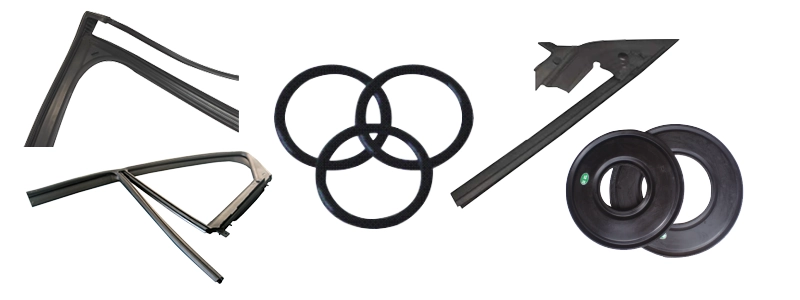
Translate Open Access into a Defined Cell Layout
The three-sided access of a C-frame structure can simplify mold work, manual loading, and auxiliary automation. That openness does not remove the need for disciplined layout planning. A C frame hydraulic press machine must be considered together with guarding, operator positions, mold-transfer paths, take-out motion, material supply, and maintenance clearance.
Every automatic movement needs a safe zone and an interlock strategy that remains practical during setup and fault recovery. Product flow must be mapped before robots or fixtures are selected. Automotive window sealing strips and door-edge seals may require controlled profile positioning at a corner joint.
Skeleton oil seals, gaskets, and overmolded bushings introduce different insert, demolding, and inspection needs. The cell design should identify how each component enters the mold, how correct placement is confirmed, and how a molded part exits without deformation or damage.
Cycle balance is another layout input. If curing time is much longer than loading or removal, a double-workstation arrangement may improve utilization, but only when the operator or automation can serve both stations without creating delays.
The assessment will need to include travel distance, confirmation time, cleaning, inspection, and recovery from a rejected insert. Simulation or a detailed timing chart can reveal conflicts before equipment positions are fixed.
Stabilize Dosing before Expanding Automation
Our RC Series separates the plasticizing and injection units. This arrangement allows material preparation and injection to be controlled independently, supporting more stable temperature management and material consistency.
Injection quantity is controlled precisely, and the nozzle can lift during vulcanization to reduce backflow and material stress. These functions create a stronger basis for automation because handling devices receive a more repeatable cycle and shot condition.
Published rubber configurations use injection pressures up to 2,500 bar and offer selectable injection volumes for small precision shots as well as larger requirements. The range extends from compact 150 kN-class equipment to models with clamping force up to 2,500 kN.
A C frame rubber injection molding machine still has to be selected by the complete application: material, cavity layout, platen size, mold clearance, opening stroke, thermal demand, and the way the part will be loaded and removed. Our engineering at Dekuma connects automation planning to the molding sequence.
Connect Useful Events instead of Collecting Every Signal
MES integration must focus on records that support production decisions. Relevant information can include work order, product and mold identifiers, recipe version, shot quantity, pressure, temperature, stroke positions, curing time, alarm history, and cycle completion. The machine-to-MES interface will need to distinguish commands from observations.
Fast control and safety remain at machine level, while production scheduling, genealogy, quality status, and performance analysis can sit in supervisory systems. A staged connection reduces commissioning risk. Read-only data collection can be verified first by comparing machine values with stored records.
Order download and recipe confirmation can follow after identifiers and permissions are stable. Any remote command requires additional state checks and cybersecurity controls. The plant needs to define how production continues during a network interruption and how delayed records are reconciled after communication returns.
Optional servo-valve control is available for applications requiring tighter pressure and flow control. Optional mold-transfer equipment can improve the speed and safety of mold changes, while a double workstation may support higher-output arrangements.
These options are not standard on every C frame hydraulic press machine. The automation specification must state which functions are included, what sensors confirm each step, and how the sequence behaves when a transfer or workstation is unavailable.
Plan for Scalable Operation and Maintainable Data
Automation may need to be added where it solves a measured constraint, such as repetitive placement, unsafe hot-part handling, long changeovers, or inconsistent removal. The business case will need to include product mix and recovery time as well as nominal cycle time.
A highly dedicated cell may suit stable volume, while a mixed-production plant may gain more from accessible tooling, stored recipes, adjustable fixtures, and well-designed assisted operation. Data also requires maintenance.
Tag names, units, sampling rules, timestamps, and recipe versions may need to be controlled so that reports remain comparable after software or tooling changes. Alarm limits need documented responses, and access rights will need to prevent unapproved settings from quietly becoming the new process standard.
Trend analysis becomes useful only when maintenance and quality teams can relate a signal to a machine event and a specific molded part. Commissioning must challenge both normal and abnormal sequences.
Teams can test a missing insert, incomplete transfer, open guard, unavailable workstation, recipe mismatch, and communication loss. The expected stop, message, recovery action, and record will need to be agreed in advance.
Training built around these cases prepares operators to restore production without bypassing protections or losing the traceability needed to investigate the event. We configure the RC Series for rubber or TPE applications and adapt the modular layout to sealing, corner-joint, overmolding, mold-handling, and cycle requirements.
Our project work at Dekuma combines that equipment work with application review, commissioning, and technical support. In a well-planned cell, open mold access enables practical handling, accurate process control supports repeatable output, and connected records help the factory manage the system over its full operating life.