
Automotive rubber components may be small in size, but they play important roles in vehicle safety, comfort, and durability. Window seals must maintain protection against water and noise, oil seals need reliable leakage prevention, dampers must provide stable vibration control, and connectors require accurate dimensions for secure assembly.
For automotive suppliers, producing these parts consistently requires more than suitable rubber materials. The molding process must maintain accurate injection volume, stable pressure, and repeatable curing conditions. Variations in product dimensions or material distribution may lead to assembly issues, reduced sealing performance, or shorter service life.
When selecting equipment for rubber injection molding for automotive industry applications, manufacturers should evaluate machine precision, production flexibility, and process stability to ensure the equipment can meet long-term manufacturing requirements.
Manufacturing Requirements for Automotive Rubber Components
Automotive rubber parts operate under different conditions depending on their application. Window seals are exposed to sunlight, rain, temperature changes, and repeated mechanical movement. Oil seals must maintain performance when contacting lubricants, while dampers require consistent elasticity to reduce vibration and improve driving comfort.
Different materials are selected according to product requirements. EPDM is widely used for automotive sealing components because of its resistance to weather aging and environmental exposure. Other rubber compounds may be applied where higher temperature resistance or specific mechanical properties are needed.
However, material selection is only one part of the production process. The molding equipment must control rubber flow, injection pressure, and curing conditions accurately. For components with complex structures, unstable processing parameters may cause incomplete filling, uneven surfaces, or dimensional variations.
For this reason, automotive manufacturers need equipment that can maintain consistent molding conditions across large production volumes.
Equipment Factors That Affect Automotive Rubber Production
When evaluating automotive rubber injection molding equipment, manufacturers should focus on the functions that directly influence product quality.
Injection accuracy is a key consideration. Automotive rubber components often include detailed structures and strict dimensional requirements. A stable injection system helps control material volume and flow, reducing differences between production cycles.
Clamping performance also affects molding results. During production, the machine must maintain stable mold locking force to prevent flash and ensure accurate part dimensions. Consistent clamping conditions help manufacturers achieve repeatable quality for large-volume production.
Production flexibility is another important factor. Automotive suppliers may produce various components, including sealing strips, gaskets, oil seals, and vibration parts. Equipment that supports different molds and material requirements allows manufacturers to respond more efficiently to changing orders.
At the same time, long-term machine reliability should be considered. Continuous automotive production requires equipment that can operate steadily with reduced maintenance interruptions.
Precision Solutions for Automotive Rubber Molding
Precision control is essential because many automotive rubber parts directly affect vehicle performance.
For window seals, accurate molding ensures proper contact with the vehicle body and supports effective sealing. For gaskets and oil seals, consistent dimensions help prevent leakage and improve component reliability.
Dampers require stable rubber performance because their function depends on consistent elasticity and shape accuracy. Even small variations between production cycles may influence vibration reduction performance.
To meet these requirements, manufacturers should examine how the machine manages injection pressure, temperature, and molding parameters. A reliable control system helps operators maintain stable production conditions and adjust processes when producing different rubber components.
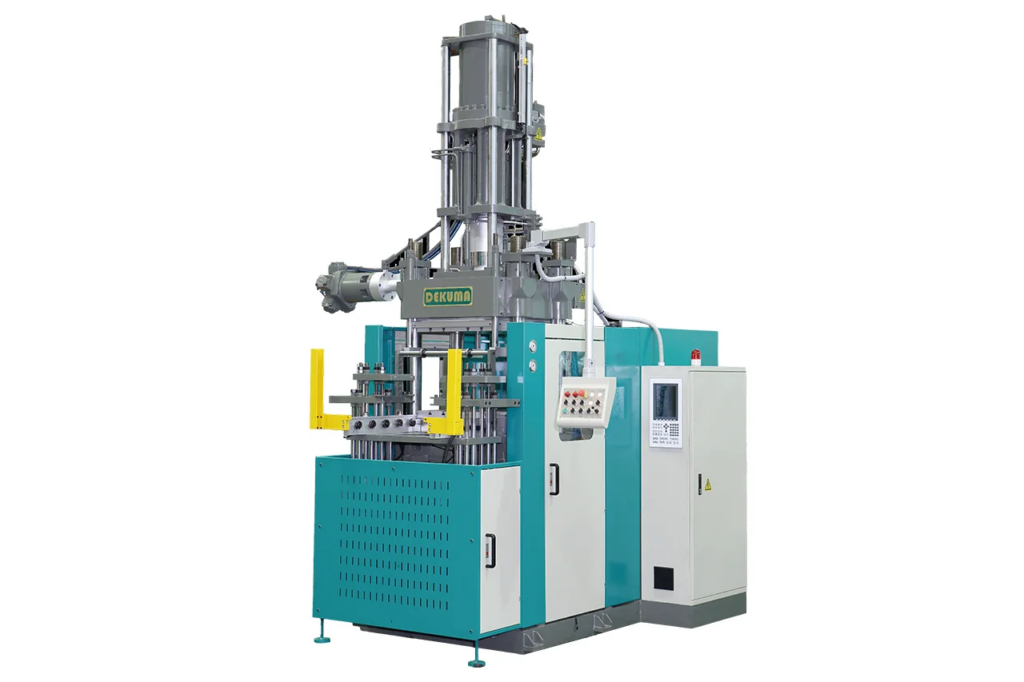
Our RV Series rubber injection molding machine is designed for automotive applications such as rubber vibration dampers, sealing components, cable connectors, and other precision rubber parts. The machine combines stable hydraulic control, optimized plasticization and injection systems, and precise electronic control to support consistent molding performance.
Our Automotive Rubber Injection Molding Equipment
With years of experience in rubber molding technology, we at Dekuma develop equipment for automotive manufacturers producing sealing parts, vibration components, and other rubber products.
Our solutions are based on actual production requirements. Product structure, rubber characteristics, mold design, and production targets are considered when selecting suitable equipment configurations.
For manufacturers producing smaller precision components, our RC Series rubber injection molding machine provides a flexible option. The C-frame structure offers convenient mold access, while its modular design supports applications such as sealing strip joints, seals, skeleton oil seals, and TPU components.
For larger automotive rubber parts, the RV and RV-Se series provide different configurations according to application needs. The RV-Se series is suitable for materials such as TPV, TPE, and flexible modified PVC, supporting production processes that require stable injection control and consistent molding quality.
Choosing the right machine depends on the relationship between product requirements and equipment capability. A suitable system should provide not only sufficient production capacity but also stable performance throughout daily operation.
Equipment Selection Based on Automotive Production Needs
Automotive suppliers rarely produce only one type of rubber component. The same production line may need to handle sealing strips, gaskets, dampers, or oil seals with different mold structures and material requirements.
When choosing equipment for rubber injection molding for automotive industry, manufacturers should check whether the machine configuration matches their actual products. Injection unit capacity, mold installation space, clamping stability, and process adjustment range all affect daily production performance.
For suppliers that frequently introduce new vehicle projects, equipment flexibility can reduce production changes. Faster mold replacement and easier parameter adjustment allow manufacturers to switch between different rubber parts more efficiently.
With practical experience in automotive rubber injection molding, we at Dekuma develop machine configurations based on specific component requirements rather than applying a single standard setup. Our equipment design considers the production characteristics of different automotive rubber parts, helping manufacturers maintain consistent results during mass production.
Choosing the right molding equipment is ultimately about matching the machine with the parts being produced. For companies using rubber injection molding for automotive industry applications, the most suitable solution is the one that can handle current products while remaining adaptable to future manufacturing needs.