
An automotive window seal, skeleton oil seal, and large TPV glass-edge component may all be classified as rubber parts, but their molding requirements can be very different. Their materials, geometries, mold structures, and injection volumes can vary considerably. A production setup that works well for one component may therefore require a different configuration for another. This is why rubber injection molding for automotive industry applications depends on more than machine capacity.
For automotive manufacturers, the more useful assessment is whether an equipment supplier can connect the material, mold, machine, and production process. Application experience becomes especially important when the product range includes precision rubber components, sealing products, damping parts, and larger molded sections.
Automotive Parts Create Different Molding Requirements
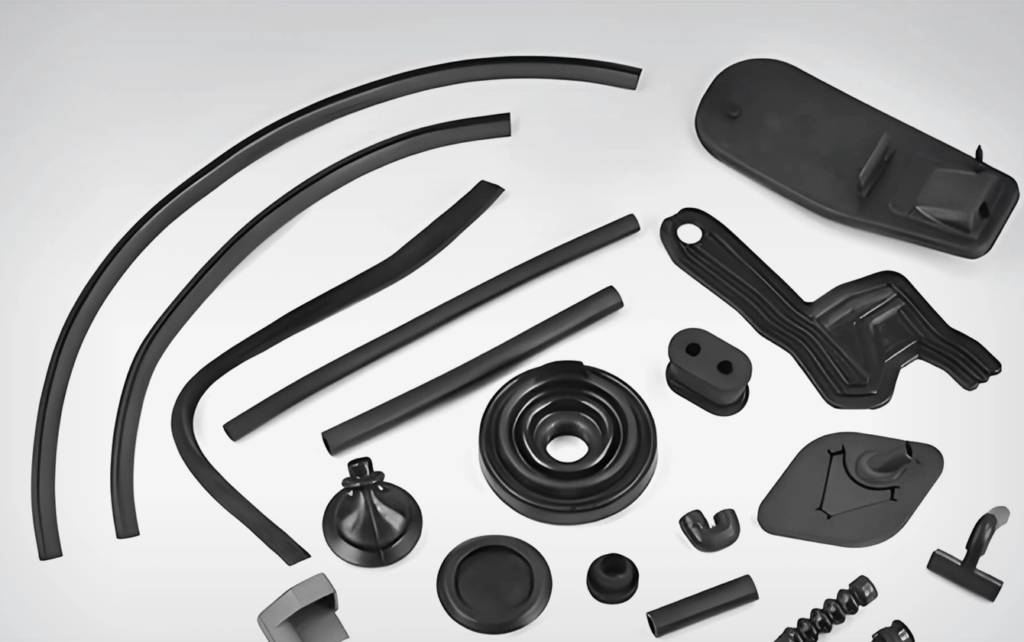
Automotive rubber applications cover sealing strips, gaskets, O-rings, cable connectors, pipe connectors, vibration absorber cylinder cushions, skeleton oil seals, and other components. Large-size TPV glass-edge applications add another type of requirement because the molded section follows the geometry of the vehicle glass.
A long sealing strip requires stable material flow along the mold and consistent dimensions across the molded profile. A skeleton oil seal has a different structure because rubber must be molded around or together with a metal insert. O-rings and gaskets are smaller, but their sealing function makes dimensional consistency important. Large TPV glass-edge applications introduce greater requirements for injection volume and mold arrangement.
These differences matter when manufacturers compare automotive injection molding companies. The number of machine models alone does not show whether a supplier understands these applications. A more useful assessment looks at the types of components, materials, tooling arrangements, and production processes that the equipment can support.
Materials Change the Equipment Requirements
Automotive applications can involve NR, NBR, EPDM, TPV, TPE, TPU, and other rubber or elastomer materials. These materials do not necessarily require identical feeding, injection, temperature, or curing conditions.
TPV and TPE, for example, are processed differently from conventional vulcanized rubber. TPU components also have their own injection requirements. The injection system therefore needs to match the material rather than treating every automotive elastomer as the same process.
The mold needs equal attention. Cavity geometry, gates, venting, parting surfaces, and insert positioning can all affect how material fills the cavity. For a sealing component, incomplete filling or dimensional variation can affect the final fit. For a component containing a metal insert, positioning must remain stable during the molding cycle.
This is why material and mold should be considered together when defining the machine configuration. The required injection volume, mold space, clamping capability, and process controls should follow the actual part rather than being selected independently.
Manufacturing Capability Goes Beyond the Machine
A capable automotive molding supplier needs more than a range of injection machines. Mold design, automation, process control, and production management can all influence how effectively a machine platform performs in a factory environment.
Our automotive equipment portfolio includes the RV Series, RV-Se Series, and RC Series. The RV Series is used for automotive and other rubber applications, while the RV-Se Series is intended for TPV, TPE, flexible modified PVC, and other injection-molded materials. The RC Series focuses on precision rubber parts, sealing-strip joints, seals, skeleton oil seals, and TPU products.
The production setup can also be adapted around the manufacturing process. Modular configurations, automation options, mold integration, process control, and production monitoring become valuable when a factory handles multiple component types. The objective is not simply to install an injection machine, but to create a setup that fits the way the automotive parts are actually produced.
For high-volume components, repeatable process parameters are particularly important. When different molds or product specifications are used, practical mold-change arrangements and parameter management can reduce unnecessary adjustment between production runs.
Application Experience Behind the Equipment
At Dekuma, our automotive application experience covers rubber damping products, skeleton oil seals, automotive rubber joints, sealing products, and other components. These applications represent different combinations of material, geometry, mold structure, and production requirements.
The RC Series provides one example of how the equipment can be configured around precision automotive rubber parts. Its design includes precise dosing, a liftable nozzle, three-side mold access, and optional mold transfer and dual-workstation functions. A servo valve option can also support pressure and flow control for applications where tighter process consistency is required.
The broader automotive equipment range allows the machine platform to be considered according to the material and product. TPV or TPE applications can be approached through the RV-Se Series, while precision rubber components and TPU products can be matched with the RC Series. This separation avoids treating every automotive molding application as if it had identical process requirements.
What Application Experience Changes in Equipment Decisions
A machine specification only becomes meaningful after it is connected to the component that will be molded. A sealing strip may require attention to material flow and mold length, while a skeleton oil seal brings insert positioning and dimensional control into the discussion. TPV glass-edge applications create another set of requirements around material handling, injection volume, and tooling space.
Production conditions add another layer to the decision. One factory may run the same component continuously, while another may switch between several molds and materials. The latter may place greater value on mold-change efficiency, parameter management, and flexible machine configurations rather than focusing only on injection capacity.
For rubber injection molding for automotive industry applications, these differences make application experience relevant to the final machine configuration. At Dekuma, the material, component geometry, tooling, and production method are considered together. For automotive injection molding companies, this provides a practical basis for determining whether the selected configuration fits the intended products and production workflow.