
In the high-precision world of rubber manufacturing, selecting the right equipment is the foundation of production efficiency. For B2B manufacturers in the automotive and electrical power industries, the vertical injection molding machine is often the preferred choice due to its space-saving design and compatibility with complex insert molding. At Dekuma, we specialize in providing advanced solutions that bridge the gap between German engineering and high-output manufacturing requirements. Understanding the technical language of this industry is essential for procurement and engineering teams to make informed decisions.
Core Terminology in Rubber Injection
When evaluating a vertical rubber injection molding machine, you will frequently encounter terms like “Clamping Force” and “Shot Volume.” Clamping force, measured in kilonewtons (kN), refers to the pressure applied to keep the mold halves securely closed against the internal injection pressure. For instance, the Dekuma RV series offers a wide range of clamping forces, from 500kN to 16,000kN, ensuring stability for diverse part sizes.
Another critical concept is “Vulcanization,” the chemical process where rubber is heated under pressure to improve its elasticity and strength. High-performance machines must provide precise temperature control to ensure uniform vulcanization across every cycle.
Feature Spotlight: The Dekuma RV Series
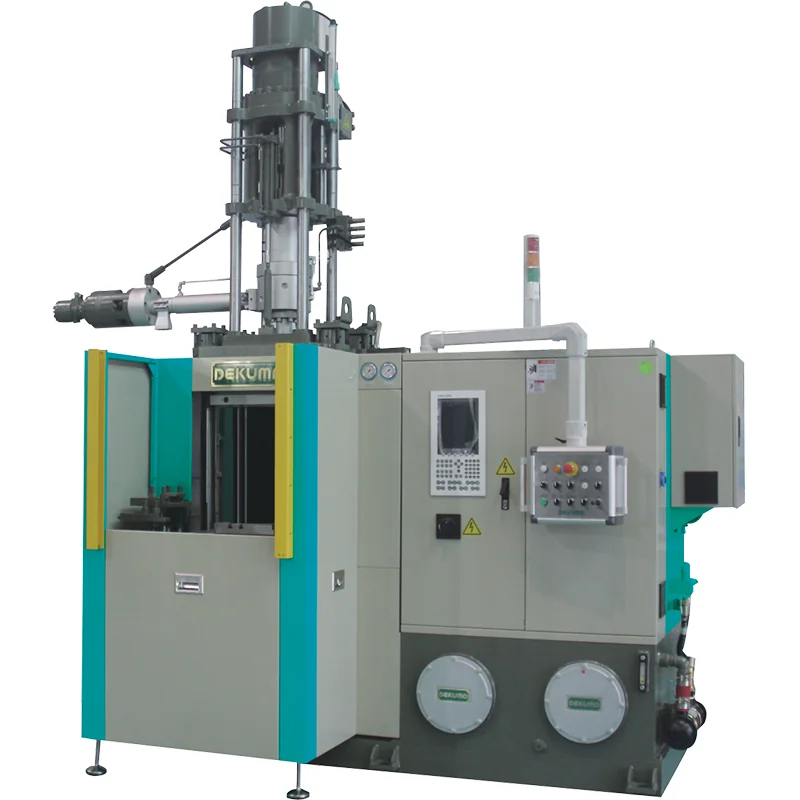
The vertical injection molding machine lineup from our RV series is specifically designed for elastomers such as NR, NBR, and EPDM. These machines are widely utilized for producing vibration absorbers, cable connectors, and sealing parts.
Key Technical Specifications of the RV Series:
Injection Pressure: Consistently maintained at 1750 bar across the DKM-RV range for superior material flow.
Repeatability: Utilizing high-precision pressure sensors and PID controllers, Dekuma machines achieve high repeatability by comparing real-time pressure and flow.
Energy Efficiency: The integrated servo system (found in the RVSe models) eliminates reactive energy consumption, potentially reducing electricity usage by 40% compared to traditional proportional control methods.
Why Choose a Vertical Rubber Injection Molding Machine?
The vertical configuration is particularly advantageous when dealing with “Inserts”—metal or plastic components placed inside the mold before the rubber is injected. Because the mold opens and closes vertically, gravity helps keep these inserts in place, reducing the risk of displacement.
A vertical rubber injection molding machine also features a smaller footprint than its horizontal counterparts, allowing factories to maximize their floor space. Dekuma enhances this advantage by incorporating European-style structures designed by German experts, ensuring that every vertical injection molding machine we deliver meets the highest standards of reliability and safety (CE certified).
By mastering these key concepts and choosing a partner like Dekuma, businesses can ensure your production lines are equipped for the future of rubber processing.