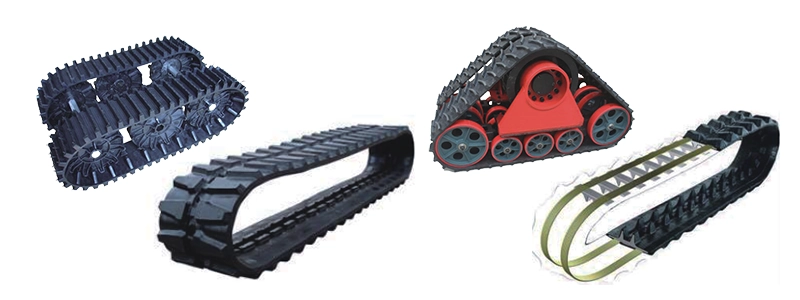
A 300 mm-wide agricultural track and a 900 mm-wide construction track create very different equipment requirements. Mold size, track length, clamping force, steel-cord tension, and vulcanization control all change with the product. The production volume also matters because manual feeding and demolding become increasingly difficult to manage as output rises.
For manufacturers comparing a rubber track machine, the starting point should therefore be the track rather than a standard machine model. The mold must fit the required track dimensions, the clamping system must handle the molding pressure, and the production line must keep the reinforcement and vulcanization process consistent from one cycle to the next.
Track Dimensions Set the Basic Machine Requirements
Track width and length determine how much usable molding space is required. Heating-plate dimensions need to accommodate the mold, while clamping force needs to correspond to the mold area and vulcanization conditions.
Our Rubber Track Production Line covers seven configurations, from DKM-RC200 to DKM-RC900. Clamping force ranges from 200 to 900 tons. Maximum track width ranges from 150–500 mm on the DKM-RC200 to 915 mm on the DKM-RC650 and DKM-RC900. The applicable track-length range extends from 2,500–3,800 mm on the DKM-RC200 to 8,000–12,000 mm on the DKM-RC900.
These figures are useful for equipment selection because they show how the production line accommodates different tooling requirements. For example, the DKM-RC200 has a 1,200 × 650 mm heating plate and can produce two cavities when the track width is below 230 mm. Larger configurations provide larger heating plates and longer track ranges for larger molds.
Steel-Cord Tension Affects Track Structure
The steel cord is embedded in the rubber track and contributes to its load-bearing structure. Its position needs to remain controlled during vulcanization. If the reinforcement shifts or tension changes during molding, the finished track may not have the intended internal structure.
Our production line combines a precision mold-clamping unit with a constant-tension steel-cord system. The vulcanizing unit and automatic tensioning system work together to produce a seamless, one-piece track rather than relying on a traditional joint. The product information states that this design can provide 30–50% longer service life than conventional jointed designs.
This is an important consideration when evaluating a rubber track vulcanizing machine. Clamping force alone does not determine track quality. The machine also needs to maintain the reinforcement arrangement while heat and pressure are applied throughout the vulcanization cycle.
Different Track Applications Require Different Configurations
Agricultural, construction, military, and snowmobile tracks do not necessarily share the same dimensions or production requirements.
Agricultural tracks may involve relatively compact track dimensions and multiple product specifications. A manufacturer producing several sizes needs a machine with enough flexibility to handle different molds without selecting excessive capacity for every job.
Construction tracks can require substantially greater width, length, and clamping capacity. The larger configurations in our production line reach 915 mm in maximum track width and 12,000 mm in track-length range, providing options for larger tooling.
Military tracks place particular importance on consistent reinforcement and repeatable vulcanization. The constant-tension steel-cord system and precision clamping unit are therefore relevant when structural consistency is a major production concern.
Snowmobile tracks have their own dimensional and operating requirements. Instead of assigning equipment according to the vehicle category alone, the machine should be selected from the actual track width, length, mold dimensions, and production volume.
The product page specifically lists all four application areas, while the machine configurations provide different combinations of clamping force, heating-plate dimensions, and track range.
Reduce Manual Handling During Production
Track production includes several repetitive operations beyond vulcanization. Rubber loading, demolding, and material retrieval can consume substantial operator time when handled manually.
Our integrated production line includes an automatic feeding unit together with automatic rubber loading, demolding, and material retrieval. According to the product specifications, this automation can reduce labor requirements by up to 50% compared with traditional machines.
This feature becomes more valuable when production involves repeated cycles or several track specifications. Operators can spend less time on repetitive handling and more time monitoring material preparation, molds, and production conditions.
The modular design also allows the equipment to accommodate different track sizes and specifications through adjustable settings. This makes automation a production-planning consideration rather than simply an additional machine feature.
Control Energy Use During Long Vulcanization Cycles
Rubber tracks require heat and pressure to complete vulcanization. During a long curing period, however, the main motor does not necessarily need to operate continuously at full output.
Our intelligent curing shutdown system automatically stops the main motor during long vulcanizing cycles while retaining lock-in pressure. The mold therefore maintains the required pressure without keeping the main motor running throughout the entire curing period. This reduces unnecessary power consumption while maintaining the pressure required for production.
For a rubber track vulcanizing machine, this is particularly relevant when long cycles are repeated throughout a production shift. Energy efficiency then depends not only on motor specifications but also on how the equipment manages periods when full hydraulic output is unnecessary.
Keep Process Settings Consistent
A factory producing several track sizes has another issue to manage: process settings must remain consistent when the mold changes.
Our equipment uses a customized B&R control system for operation, temperature control, and recipe management. Multiple production recipes can be stored, allowing different track specifications to use predefined process settings instead of requiring operators to rebuild them manually.
The system also connects with our iSee4.0 intelligent management cloud platform. Production teams can monitor energy consumption, temperature, pressure, clamping force, and time in real time. Remote monitoring also supports equipment-status oversight and maintenance management.
These functions become useful when several track specifications share the same production line. Recipe management handles the repeatability of the process, while real-time data provides a way to identify deviations in temperature, pressure, or cycle time.
Match the Equipment to the Track Specification
The practical selection process can begin with the track width, track length, mold dimensions, and required output. These determine the necessary heating-plate size, track range, and clamping capacity. The reinforcement structure then determines how steel-cord tension needs to be controlled, while production volume influences the level of automation required.
Our equipment range provides seven configurations with clamping forces from 200 to 900 tons and track-length ranges from 2,500–3,800 mm to 8,000–12,000 mm. This makes the selection more specific than simply choosing a machine according to the application category.
At Dekuma, the Rubber Track Production Line combines the vulcanizing equipment with automatic feeding, demolding, material retrieval, constant-tension steel-cord control, intelligent curing shutdown, and process monitoring. The configuration can then be matched to the actual mold and track specification rather than treating agricultural, construction, military, and snowmobile tracks as one production category.
When evaluating a rubber track machine, the useful comparison is therefore the complete production requirement: available mold space, track dimensions, clamping capacity, reinforcement control, handling method, vulcanization cycle, and process monitoring. These factors determine whether the equipment can support the track specifications and production conditions that the factory actually needs.